
Liturgy News
Vol 55 No 4 December 2025
Contents
| Title | Author | Topic | Page |
|---|---|---|---|
| Editor: Prioritising Baptism | Elich, Tom | Baptism | 2-3 |
| Bringing Children to Encounter Christ through their First Holy Communion | Orji, Stanley | Children and Youth | 3-5 |
| Listening to High School Students | Crooks, Gerry | Schools | 6-7 |
| Witnesses of the Living Hope: A Reflection on Volunteering in Jubilee 2025 | Chan, Pius | Evangelisation and Mission | 8-10 |
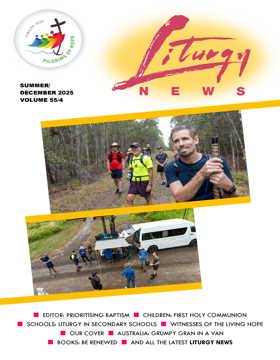
| Our Cover: Emmanuel City Mission Pilgrimage | - | Evangelisation and Mission | 10 |
| Pope Leo on Liturgical Singing | - | Music | 11 |
| Polygamy | - | Marriage | 11 |
| Tridentine Mass | - | Eucharist / Mass | 11 |
| Liturgical Formation | - | Symbols | 11 |
| Sainthood | - | Saints | 12 |
| Synod Liturgy Group | - | Liturgy and Governance | 12 |
| Liturgy Committees | - | Liturgy and Governance | 12 |
| Women Deacons | - | Ministries – Liturgical | 12 |
| Ecumenism and Liturgy | - | Liturgy - Other Churches/Religions | 13 |
| Nicaea | - | Texts – Liturgical | 13 |
| Lectionary Report | - | Texts – Liturgical | 13 |
| ACU Centre for Liturgy | - | People | 13 |
| Eucharistic Congress | - | Eucharist / Mass | 14 |
| Altar Wine | - | Eucharist / Mass | 14 |
| Role of Mary | - | Mary, Mother of God | 14 |
| National Liturgy Conference - Pilgrims of Hope | - | Conferences and Special Events | 14 |
| Grumpy Gran in a Van? A Grey Nomad’s View of Travelling to Mass | Johnson, Mary-Anne | Evangelisation and Mission | 15 |
| Books: Be Renewed. A Guide to the Sacrament of Reconciliation by Paul Turner | Cronin, James | Penance | 16 |
Editorial
Prioritising Baptism
Elich, Tom
I don’t like talking about ‘The Laity’ and try to avoid it when I can. The term implies its counterpart, ‘The Clergy’. Talking about the clergy and the laity creates a separation among the baptised who make up the Body of Christ. A priest’s ordination does not override his baptism; it adds a new dimension to it. All who are baptised are one in Christ – there is no longer Jew or Greek, slave or free, male or female (Gal 3:28).
In the last few years, we’ve been reflecting on the idea of SYNODALITY. The fundamental theological insight underlying it is our common baptism. This sacrament unites us to Christ and makes us part of the Body of Christ, the Church. Synodality starts here and recognises that, as a consequence, all the baptised share in the mission of Christ to announce the kingdom of God. Hence, we need to listen to one another and be open to the work of the Spirit. We need to respond to one another and work together collaboratively to proclaim the gospel.
Pope Leo, in his recent interviews with Elise Allen, said: Synodality is a way of describing how we can come together and be a community and seek communion as a Church, so that it’s a Church whose primary focus is not on an institutional hierarchy, but rather on a sense of we together, our Church…
Critics of synodality are afraid that it will lead to populist or democratic heresies and that it will undermine the structures of authority and governance in the Church. These critics forget that all leadership in the Church is centred on service, after the model of Christ who came to serve, not to be served. They underestimate the power of the process of discernment in the Spirit in which the truth is revealed.
It is the LITURGY which provides the best model for a synodal Church. ‘Who celebrates the liturgy?’, asks the Catholic Catechism. Christ does, it answers, the whole Christ (Christus totus), that is, the entire body of the baptised (CCC 1136, 1140). This is the meaning of Vatican Council II’s emphasis on full, conscious, active participation in the liturgy (SC 14). Note that this comes about as the right and duty of all the baptised. All – laity and clergy alike – participate in what Christ is doing. Sometimes this is misunderstood. People think that they are participating in what the priest is doing. Rather, all the baptised are the ‘doers’ of the liturgical action.
What then is the role of the ordained minister in the liturgy? He presides. By ordination, he is given the role and responsibility of speaking on behalf of all and drawing everyone into sacramental action. This was spelled out very clearly by Pope Francis in Desiderio Desideravi (2022).
* What is the content of the liturgy? Christ’s action in his death and resurrection. The content of the bread broken is the cross of Jesus, his sacrifice of obedience out of love for the Father (DD 7).
* Who celebrates the liturgy? The whole body of the baptised. The subject acting in the liturgy is always and only Christ-Church, the mystical Body of Christ (DD 15; also 19 and 36).
* What then does the priest do? He is the presider within the Body of Christ.The priest lives his characteristic participation in the celebration [of Eucharist] in virtue of the gift received in the sacrament of Holy Orders, and this is expressed precisely in presiding… this is a consequence of the outpouring of the Holy Spirit received in ordination…(DD 65)
We can see here how the liturgy provides a model for the way parish and diocesan life unfolds in a synodal manner. All the baptised listen to one another and discern the movement of the Spirit. Parish Pastoral Councils, Finance Councils, Sacramental Programs, all operate collaboratively – with the priest presiding, that is, facilitating everyone’s contribution, reconciling, and articulating a common vision on behalf of all. This is a far cry from the old rhetoric which said that parish groups are ‘merely consultative’ with the priest able to ignore the recommendations at will.
The baptismal context allows us to make sense of lay leadership. We have instituted ministries of acolyte, lector and catechist. Lay people can lead the Sunday Liturgy of the Word and preach where it is necessary or advantageous. The laity may be allowed to preach in a church or oratory if in certain circumstances it is necessary or in particular cases it would be advantageous (CCL 766). Here we have a broad vision of collaboration among all the baptised.
Dividing the Body of Christ into clergy and laity is not the only way in which our ‘one baptism’ is compromised. There are also important ECUMENICAL dimensions to prioritising baptism and affirming the unity of all the baptised in Christ.
There was a time when we spoke collectively of ‘non-Catholics’. This is most unhelpful because it divides those who have been baptised into us and them. The baptised who are not us are lumped together with people who follow another religion or no religion at all. In fact, Catholics share a close and intimate relationship with members of the Anglican and Uniting Churches, Lutherans and Pentecostals, and all the baptised because in fact we are all one in Christ. Certainly, there is a variety of Christian traditions but the baptismal unity we share is much more significant than anything that makes us different.
It is a serious offence therefore when parishes establish a process for the Christian initiation of
adults and, with scarcely any differentiation, put together in one and the same category both those
who are already baptised in Christ and also those who come from another religion or who have no
religion. The journey for those who are coming to Christ must follow a very different trajectory
from those who are already claimed for Christ and who wish to move from one tradition to another.
The rite of reception into full communion for someone who is already baptised is utterly simple:
they affirm that they share our faith in Christ, and they are then confirmed and admitted to the
table of the Eucharist. That’s it.
If we look at the original Latin version of the Rite for the Christian Initiation of Adults (what
we call the editio typica), it does not deal at all with the reception into full communion of those
baptised in other Churches. There are only two pages of pastoral notes relating to those who were
baptised Catholics in infancy but who have neither been catechised or received the sacraments. The
rite acknowledges that their catechetical formation might take some time and be akin to what is
required of catechumens. But the rationale of their journey is different. This would also be the
case for those already baptised in another Christian tradition.
By comparison with initiating catechumens, receiving baptised Christians into full communion is a
small step. Many of them may know Christ and the gospel; many will share our faith in the Eucharist
and the encounter with Christ that it offers. Prioritising our baptism reactivates our yearning for intercommunion. It stands at the nexus of ecclesial and sacramental unity.
Tom Elich
Editor