
Liturgy News
Vol 56 No 1 March 2026
Contents
| Title | Author | Topic | Page |
|---|---|---|---|
| Editor: Eucharistic Congress | Elich, Tom | Eucharist / Mass | 2-3 |
| The Virgin Mary and the Liturgy | O'Brien, Jenny | Mary, Mother of God | 3-5 |
| Celebrating the Liturgy with Children: A Vision for Engagement | Schwantes, Clare and Mangan, Michael | Children and Youth | 6-8 |
| Latin Music and the Liturgical Assembly | Kirkpatrick, Bernard | Music | 9-11 |
| The nuts and bolts of the Easter Vigil | Elich, Tom | Easter and Lent | 11-13 |
| Breaking Down Barriers Gently | Bachmann, Helen | Australian Artists | 14-15 |
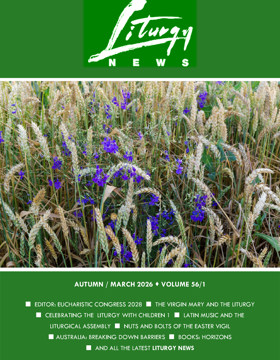
| Our Cover: Parables of the Kingdom | - | Word | 15 |
| Words that Wound | - | Easter and Lent | 16 |
| St John Henry Newman | - | People | 16 |
| The Good Shepherd | - | Art | 16 |
| Liturgy Consultation | - | Liturgy | 16 |
| German Synodal Way | - | Preaching | 16 |
| Liturgy at Cardinals' Meeting | - | Eucharist / Mass | 17 |
| Year of Francis | - | Conferences and Special Events | 17 |
| Televised Mass | - | Eucharist / Mass | 17 |
| Papal Staff | - | Art | 17 |
| Liturgy Councils | - | People | 17 |
| Participation of Women | - | Justice and Liturgy | 18 |
| Books: JP Grayland, Horizons: Essays on Synodality, Liturgy and Global Catholicism | Cronin, James | Liturgy and Governance | 18 |
Editorial
The 54th International Eucharistic Congress 2028
Elich, Tom
I was delighted when I saw that the theme for the 2028 Eucharistic Congress was ‘This is my body given for you’ because it takes us directly to the action of Christ. Christ speaks these words at the Last Supper and they are fulfilled on the cross. In his magnificent letter on the liturgy, Desiderio Desideravi, Pope Francis affirmed that this is indeed the heart of the Eucharist: The content of the bread broken is the cross of Jesus… it is of this that we make memorial in every Eucharist (DD 7).
The pope speaks of our amazement, astonishment and wonder at the Eucharist, at the fact that the paschal mystery is rendered present in the concreteness of sacramental signs (DD 24). The astonishment or wonder of which I speak is not some sort of being overcome in the face of an obscure reality or a mysterious rite. It is, on the contrary, marvelling at the fact that the salvific plan of God has been revealed in the paschal deed of Jesus, and the power of this paschal deed continues to reach us in the celebration of the ‘mysteries’ of the sacraments (DD 25). Wonder is an essential part of the liturgical act because it is the way that those who know they are engaged in the particularity of symbolic gestures look at things. It is the marvelling of those who experience the power of symbol, which does not consist in referring to some abstract concept but rather in containing and expressing in its very concreteness what it signifies (DD 26).
At this early stage, these insights are not prominent in the preparatory materials available on the Congress website. Instead there is a laudable focus on celebrating the liturgy prayerfully and with reverence, and an emphasis on exposition and adoration of the Blessed Sacrament. Resources are offered to help understand the real presence of Christ in the Eucharist. However, the nature of ‘sacrament’ is left unexplored. Yet it is exactly by means of signs that we are taken to the heart of the saving mystery (DD 21).
One of the prominent themes in Pope Francis’ letter is that, in order to encounter Christ in the Eucharist, we need to become capable of symbols, to recover the capacity to engage with symbolic action which is an essential trait of the liturgical act (DD 44, 27). It is by means of the sacramental sign that we are able to access the reality of what Christ is doing. This is not an act of the imagination. When we look at the consecrated host in the monstrance, we are seeing bread with our eyes; but with our heart and mind, our faith, we know the bread as a sacramental sign, a window to a new reality. This is a much stronger reality than just imagining that Christ is looking back at us as if from behind a curtain.
Now if the sacramental sign is our opening to a real encounter with Christ, we need to make our signs well. The Eucharistic Congress is an opportunity for parish communities to understand how to make the sacramental signs more effective – to encourage communities to offer communion from the altar, not from the tabernacle; to use eucharistic bread which is substantial and which can be broken and shared among the people; to offer people communion from the cup at every Mass. The importance of actions like this are clearly explained in the Missal introduction. By reason of the sign, it is required that the material for the eucharistic celebration truly have the appearance of food (GIRM 321). It goes on to explain the importance of the fraction rite as a sign of unity in sharing the one bread.
The Missal introduction explains how important it is to have communion from the cup. It is a fuller sign. It opens up the reality that the new covenant in Christ is ratified in his blood and it establishes a deeper connection between the eucharistic banquet and the eschatological banquet in the Kingdom of God (GIRM 281). These questions are by no means insignificant yet, at this point, the preparatory materials provided for the Congress do not address these questions or promote these liturgical practices.
CHRIST AS CELEBRANT
Given what we have said about the paschal mystery as the content of the liturgy, it is clear that it is Christ who is the celebrant of the liturgy. This means that the liturgy is celebrated by the whole Church, the Body of Christ. All the baptised are the ‘doers’ of the Eucharist. This is repeatedly affirmed by Pope Francis in Desiderio Desideravi: The subject acting in the liturgy is always and only Christ-Church, the mystical Body of Christ (DD 15). Let us always remember that it is the Church, the Body of Christ, that is the celebrating subject and not just the priest (DD 36).
The people are not participating in what the priest is doing; rather all the baptised (priest and people together) are participating in what Christ is doing. What then is the priest’s role as an ordained minister? He presides! The priest lives his characteristic participation in the celebration in virtue of the gift received in the sacrament of Holy Orders, and this is expressed precisely in presiding. [This is] … a consequence of the outpouring of the Holy Spirit received in ordination which equips him for such a task (DD 56).
This understanding of the eucharistic action emphasises the profoundly communal nature of the liturgy. Here is another dimension not yet adequately expressed in the early documentation for the Eucharistic Congress. It helpfully emphasises contemplation and adoration but this easily falls into a personal and individual faith. Pope Francis offers a correction. The action of the celebration does not belong to the individual but to the Christ-Church, to the totality of the faithful united in Christ. The liturgy does not say ‘I’ but ‘we’, and any limitation on the breadth of this ‘we’ is always demonic. The liturgy does not leave us alone to search out an individual supposed knowledge of the mystery of God. Rather, it takes us by the hand, together, as an assembly, to lead us deep within the mystery that the Word and the sacramental signs reveal to us. And it does this, consistent with all action of God, following the way of the Incarnation, that is, by means of the symbolic language of the body, which extends to things in space and time (DD 19).
A communal awareness in the liturgy even gives us a new perspective on silence which ought to be an integral part of every liturgy. Silence belongs to the whole assembly. Such silence is not an inner haven in which to hide oneself in some sort of intimate isolation, as if leaving the ritual form behind as a distraction. That kind of silence would contradict the essence itself of the celebration. Liturgical silence is something much more grand: it is a symbol of the presence and action of the Holy Spirit who animates the entire action of the celebration (DD 52).
We still have a couple of years to go. The 2028 Eucharistic Congress is a unique opportunity for parish renewal. I have quoted extensively from Pope Francis’ 2022 Apostolic Letter because I believe it has some key insights that we need to recognise in order to make our eucharistic renewal not just spiritual but also properly liturgical.